Everyday Genius Selftaught Art and the Culture of Authenticity Summary
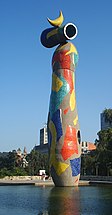
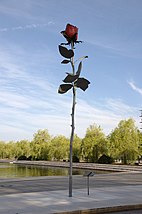
Contemporary art is the fine art of today, produced in the second half of the 20th century or in the 21st century. Contemporary artists work in a globally influenced, culturally various, and technologically advancing world. Their art is a dynamic combination of materials, methods, concepts, and subjects that continue the challenging of boundaries that was already well underway in the 20th century. Diverse and eclectic, contemporary art as a whole is distinguished by the very lack of a uniform, organising principle, credo, or "-ism". Gimmicky fine art is function of a cultural dialogue that concerns larger contextual frameworks such equally personal and cultural identity, family, community, and nationality.
In vernacular English, modern and contemporary are synonyms, resulting in some conflation and confusion of the terms modern art and contemporary art by not-specialists.[1]
Telescopic [edit]
Some define contemporary fine art equally art produced within "our lifetime," recognising that lifetimes and life spans vary. However, there is a recognition that this generic definition is subject to specialized limitations.[2]
The classification of "gimmicky art" as a special type of art, rather than a full general adjectival phrase, goes back to the beginnings of Modernism in the English-speaking globe. In London, the Gimmicky Fine art Society was founded in 1910 by the critic Roger Fry and others, as a private gild for buying works of fine art to place in public museums.[iii] A number of other institutions using the term were founded in the 1930s, such equally in 1938 the Contemporary Art Society of Adelaide, Australia,[iv] and an increasing number after 1945.[5] Many, similar the Plant of Contemporary Art, Boston changed their names from ones using "Modern fine art" in this period, every bit Modernism became defined as a historical art move, and much "modern" art ceased to be "contemporary". The definition of what is contemporary is naturally always on the move, anchored in the present with a beginning date that moves forward, and the works the Contemporary Art Lodge bought in 1910 could no longer be described equally contemporary.

Particular points that have been seen as mark a modify in art styles include the end of Earth War Ii and the 1960s. There has perhaps been a lack of natural intermission points since the 1960s, and definitions of what constitutes "contemporary art" in the 2010s vary, and are mostly imprecise. Art from the past 20 years is very likely to exist included, and definitions often include fine art going back to about 1970;[6] "the art of the late 20th and early 21st century";[vii] "both an outgrowth and a rejection of mod fine art";[8] "Strictly speaking, the term "contemporary art" refers to art made and produced by artists living today";[nine] "Art from the 1960s or [19]70s up until this very minute";[10] and sometimes further, specially in museum contexts, as museums which form a permanent drove of contemporary art inevitably notice this crumbling. Many use the conception "Mod and Contemporary Fine art", which avoids this trouble.[11] Smaller commercial galleries, magazines and other sources may use stricter definitions, perhaps restricting the "contemporary" to work from 2000 onwards. Artists who are still productive afterward a long career, and ongoing art movements, may present a detail issue; galleries and critics are oft reluctant to divide their work between the contemporary and non-gimmicky.[ citation needed ]
Sociologist Nathalie Heinich draws a distinction between modern and contemporary art, describing them as two unlike paradigms which partially overlap historically. She found that while "modernistic art" challenges the conventions of representation, "contemporary art" challenges the very notion of an artwork.[12] She regards Duchamp's Fountain (which was made in the 1910s in the midst of the triumph of modernistic art) as the starting betoken of contemporary art, which gained momentum later World War 2 with Gutai's performances, Yves Klein's monochromes and Rauschenberg'due south Erased de Kooning Drawing.[xiii]
Themes [edit]

Irbid, Hashemite kingdom of jordan, "We are Arabs. We are Humans". Inside Out is a global participatory art projection, initiated by the French photographer JR, an example of Street art
Contemporary artwork is characterised by diversity: diversity of fabric, of form, of subject matter, and even time periods. Information technology is "distinguished by the very lack of a uniform organizing principle, ideology, or - ism"[fourteen] that is seen in many other fine art periods and movements. The focus of Modernism is self-referential. Impressionism looks at our perception of a moment through light and color, equally opposed to the attempt to reverberate stark reality in Realism. Gimmicky fine art, on the other paw, does not take one, single objective or indicate of view, so information technology tin exist contradictory and open up-ended. There are nonetheless several common themes that have appeared in contemporary works, such as identity politics, the body, globalization and migration, applied science, contemporary society and culture, time and memory, and institutional and political critique.[15]
Institutions [edit]


The operation of the art world is dependent on art institutions, ranging from major museums to private galleries, non-profit spaces, art schools and publishers, and the practices of individual artists, curators, writers, collectors, and philanthropists. A major division in the art world is between the for-profit and non-profit sectors, although in recent years the boundaries between for-profit private and non-profit public institutions have get increasingly blurred.[ citation needed ] Nearly well-known gimmicky art is exhibited past professional artists at commercial contemporary art galleries, by private collectors, art auctions, corporations, publicly funded arts organizations, gimmicky art museums or by artists themselves in artist-run spaces.[sixteen] Contemporary artists are supported past grants, awards, and prizes equally well every bit by direct sales of their work. Career artists train at fine art school or sally from other fields.[ commendation needed ]
There are close relationships between publicly funded gimmicky art organizations and the commercial sector. For instance, in 2005 the volume Agreement International Art Markets and Management reported that in Uk a handful of dealers represented the artists featured in leading publicly funded gimmicky art museums.[17] Commercial organizations include galleries and art fairs.[xviii]
Corporations accept also integrated themselves into the gimmicky art world, exhibiting contemporary art within their premises, organizing and sponsoring contemporary art awards, and building upwards extensive corporate collections.[19] Corporate advertisers oft utilise the prestige associated with contemporary art and coolhunting to draw the attention of consumers to luxury appurtenances.[20]
The institutions of art accept been criticized for regulating what is designated as gimmicky fine art. Outsider art, for example, is literally contemporary art, in that it is produced in the present twenty-four hours. Notwithstanding, one critic has argued it is not considered so because the artists are self-taught and are thus assumed to be working outside of an art historical context.[21] Craft activities, such equally cloth design, are also excluded from the realm of contemporary art, despite big audiences for exhibitions.[22] Art critic Peter Timms has said that attention is drawn to the way that craft objects must subscribe to item values in social club to exist admitted to the realm of gimmicky fine art. "A ceramic object that is intended as a subversive comment on the nature of dazzler is more likely to fit the definition of gimmicky art than one that is merely beautiful."[23]
At any once a particular place or group of artists can have a potent influence on subsequent contemporary art. For case, The Ferus Gallery was a commercial gallery in Los Angeles and re-invigorated the Californian gimmicky fine art scene in the late fifties and the sixties.
Public attitudes [edit]
Gimmicky art can sometimes seem at odds with a public that does not feel that art and its institutions share its values.[24] In Britain, in the 1990s, gimmicky fine art became a part of popular culture, with artists becoming stars, just this did not lead to a hoped-for "cultural utopia".[25] Some critics like Julian Spalding and Donald Kuspit have suggested that skepticism, even rejection, is a legitimate and reasonable response to much contemporary art.[26] Brian Ashbee in an essay called "Art Bollocks" criticizes "much installation art, photography, conceptual art, video and other practices generally called post-modern" every bit being too dependent on verbal explanations in the form of theoretical discourse.[27] Nevertheless, the credence of non traditional fine art in museums has increased due to changing perspectives on what constitutes an art piece.[28]
Concerns [edit]
A common concern since the early part of the 20th century has been the question of what constitutes art. In the contemporary period (1950 to now), the concept of advanced[29] may come into play in determining what art is noticed by galleries, museums, and collectors.
The concerns of contemporary fine art come in for criticism too. Andrea Rosen has said that some contemporary painters "take absolutely no thought of what information technology means to be a contemporary artist" and that they "are in information technology for all the wrong reasons."[30]
Prizes [edit]
Some competitions, awards, and prizes in contemporary fine art are:
- Emerging Artist Honor awarded by The Aldrich Contemporary Art Museum
- Gene Prize in Southern Art
- Hugo Boss Prize awarded by the Solomon R. Guggenheim Museum
- John Moore's Painting Prize
- Kandinsky Prize for Russian artists nether 30
- Marcel Duchamp Prize awarded by ADIAF and Center Pompidou
- Ricard Prize for a French creative person under 40
- Turner Prize for British artists
- Participation in the Whitney Biennial
- Vincent Award, The Vincent van Gogh Biennial Honor for Contemporary Art in Europe
- The Winifred Shantz Award for Ceramists, awarded by the Canadian Clay and Drinking glass Gallery
- Asia Pacific Breweries Foundation Signature Art Prize[31]
- Jindřich Chalupecký Award for Czech artists under 35[32]
History [edit]
This table lists art movements and styles by decade. It should non be causeless to exist conclusive.
1950s [edit]
| 1960s [edit]
| 1970s [edit]
| 1980s [edit]
| 1990s [edit]
| 2000s [edit]
2010s [edit]
|
See also [edit]
- Acculturation
- Anti-art and Anti-anti-art
- Art:21 - Art in the 21st Century (2001-2016), a PBS series
- Criticism of postmodernism
- Classificatory disputes about art
- Listing of contemporary art museums
- List of gimmicky artists
- Medium specificity
- Reductive art
- Value theory
- Visual arts
- Discussion art
- New media art
Notes [edit]
- ^ NYU Steinhardt, Department of Art and Arts Professions, New York
- ^ Esaak, Shelley. "What is "Gimmicky" Fine art?". Nearly.com . Retrieved 28 April 2013.
- ^ Fry Roger, Ed. Craufurd D. Goodwin, Art and the Marketplace: Roger Fry on Commerce in Fine art, 1999, Academy of Michigan Printing, ISBN 0472109022, 9780472109029, google books
- ^ Also the Contemporary Arts Society of Montreal, 1939–1948
- ^ Smith, 257–258
- ^ Some definitions: "Art21 defines gimmicky art every bit the work of artists who are living in the twenty-first century." Art21
- ^ "Gimmicky art - Define Gimmicky fine art at Dictionary.com". Lexicon.com.
- ^ "Yahoo". Archived from the original on 2013-07-20.
- ^ "About Gimmicky Fine art (Education at the Getty)".
- ^ Shelley Esaak. "What is Gimmicky Art?". Virtually.com Education.
- ^ Examples of specializing museums include the Strasbourg Museum of Modern and Gimmicky Art and Museum of Mod and Contemporary Art of Trento and Rovereto. The Oxford Dictionary of Modern and Contemporary Fine art is one of many book titles to use the phrase.
- ^ Heinich, Nathalie, Ed. Gallimard, Le paradigme de l'fine art contemporain : Structures d'une révolution artistique , 2014, ISBN 2070139239, 9782070139231, google books
- ^ Nathalie Heinich lecture "Contemporary art: an artistic revolution ? at 'Agora des savoirs' 21st edition, 6 May 2015.
- ^ Contemporary Fine art in Context. (2016). Retrieved Dec 11, 2016
- ^ Robertson, J., & McDaniel, C. (2012). Themes of Contemporary Art: Visual Art later on 1980 (3rd ed.). Oxford: Oxford University Press.
- ^ "Largest Fine art & Linguistic communication Collection Finds Abode - artnet News". artnet News. 2015-06-23. Retrieved 2018-09-ten .
- ^ Derrick Chong in Iain Robertson, Understanding International Art Markets And Management, Routledge, 2005, p95. ISBN 0-415-33956-1
- ^ Grishin, Sasha. "With commercial galleries an endangered species, are art fairs a necessary evil?". The Conversation . Retrieved 2019-12-05 .
- ^ Chin-Tao Wu, Privatising Culture: Corporate Art Intervention Since the 1980s, Verso, 2002, p14. ISBN 1-85984-472-3
- ^ Jasmin Mosielski, Coolhunting: Evaluating the Capacity for Agency and Resistance in the Consumption of Mass Produced Culturally-Relevant Goods (Ph.D. diss., Carleton Univ., 2012); and Peter Andreas Gloor and Scott M. Cooper, Coolhunting: Chasing Downwards the Next Big Matter (NYC: AMACOM, 2007), 168-70. ISBN 0814400655
- ^ Gary Alan Fine, Everyday Genius: Self-Taught Art and the Culture of Actuality, University of Chicago Press, 2004, pp42-43. ISBN 0-226-24950-6
- ^ Peter Dormer, The Civilization of Craft: Status and Future, Manchester University Press, 1996, p175. ISBN 0-7190-4618-one
- ^ Peter Timms, What'due south Wrong with Contemporary Art?, UNSW Printing, 2004, p17. ISBN 0-86840-407-ane
- ^ Mary Jane Jacob and Michael Brenson, Conversations at the Castle: Irresolute Audiences and Contemporary Fine art, MIT Press, 1998, p30. ISBN 0-262-10072-X
- ^ Julian Stallabrass, High Art Lite: British Art in the 1990s, Verso, 1999, pp1-2. ISBN ane-85984-721-8
- ^ Spalding, Julian, The Eclipse of Art: Tackling the Crisis in Art Today, Prestel Publishing, 2003. ISBN three-7913-2881-6
- ^ "Art Bollocks". Ipod.org.britain. 1990-05-05. Archived from the original on 16 July 2011. Retrieved 2011-08-17 .
- ^ "What is Art? | Boundless Fine art History". courses.lumenlearning.com . Retrieved 2018-05-04 .
- ^ Fred Orton & Griselda Pollock, Avant-Gardes and Partisans Reviewed. Manchester Academy, 1996. ISBN 0-7190-4399-9
- ^ Haas, Nancy (2000-03-05), "Stirring Upwards the Art World Over again". The New York Times, [i].
- ^ "Signature Art Prize - Home". Archived from the original on 2014-eleven-06.
- ^ Jindřich Chalupecký Award Archived 2007-09-27 at the Wayback Machine
References [edit]
- Smith, Terry (2009). What Is Contemporary Fine art?. Chicago: University of Chicago Press. ISBN978-0226764313 . Retrieved 26 April 2013.
- Meyer, Richard (2013). What Was Gimmicky Art?. Cambridge: MIT Press. ISBN978-0262135085 . Retrieved 26 October 2014.
Further reading [edit]
- Altshuler, B. (2013). Biennials and Across: Exhibitions that Made Art History: 1962-2002. New York, N.Y.: Phaidon Press, ISBN 978-0714864952
- Atkins, Robert (2013). Artspeak: A Guide To Gimmicky Ideas, Movements, and Buzzwords, 1945 To the Present (3rd. ed.). New York: Abbeville Press. ISBN978-0789211514.
- Danto, A. C. (2013). What is art. New Haven: Yale University Press, ISBN 978-0300205718
- Desai, V. Due north. (Ed.). (2007). Asian art history in the twenty-first century. Williamstown, Mass.: Sterling and Francine Clark Art Institute, ISBN 978-0300125535
- Fullerton, E. (2016). Artrage! : the story of the BritArt revolution. London: Thames & Hudson Ltd, ISBN 978-0500239445
- Gielen, Pascal (2009). The Murmuring of the Creative Multitude: Global Art, Memory and Mail-Fordism. Amsterdam: Valiz, ISBN 9789078088394
- Gompertz, W. (2013). What Are You lot Looking At?: The Surprising, Shocking, and Sometimes Foreign Story of 150 Years of Modern Art (2nd ed.). New York, North.Y.: Plume, ISBN 978-0142180297
- Harris, J. (2011). Globalization and Contemporary Art. Hoboken, Due north.J.: Wiley-Blackwell, ISBN 978-1405179508
- Lailach, M. (2007). State Art. London: Taschen, ISBN 978-3822856130
- Martin, S. (2006). Video Art. (U. Grosenick, Ed.). Los Angeles: Taschen, ISBN 978-3822829509
- Mercer, K. (2008). Exiles, diasporas & strangers. Cambridge, Massachusetts: MIT Press, ISBN 978-0262633581
- Robertson, J., & McDaniel, C. (2012). Themes of Contemporary Art: Visual Art afterward 1980 (tertiary ed.). Oxford: Oxford University Printing, ISBN 978-0199797073
- Robinson, H. (Ed.). (2015). Feminism-art-theory : an anthology 1968-2014 (2nd ed.). Chichester, West Sussex: Wiley-Blackwell, ISBN 978-1118360590
- Stiles, Kristine and Peter Howard Selz, Theories and Documents of Contemporary Fine art, A Sourcebook of Artists'due south Writings (1996), ISBN 0-520-20251-one
- Strehovec, J. (2020).Gimmicky Art Impacts on Scientific, Social, and Cultural Paradigms: Emerging Enquiry and Opportunities. Hershey, PA: IGIGlobal.
- Thompson, D. (2010). The $12 Million Stuffed Shark: The Curious Economics of Gimmicky Art. New York, N.Y.: St. Martin'south Griffin, ISBN 978-0230620599
- Thorton, South. (2009). Seven Days in the Art Globe. New York, Due north.Y.: W.Due west. Norton & Company, ISBN 978-0393337129
- Wallace, Isabelle Loring and Jennie Hirsh, Gimmicky Fine art and Classical Myth. Farnham: Ashgate (2011), ISBN 978-0-7546-6974-6
- Warr, T. (Ed.). (2012). The Artist's Body (Revised). New York, N.Y.: Phaidon Press, ISBN 978-0714863931
- Wilson, M. (2013). How to read contemporary art : experiencing the art of the 21st century. New York, N.Y.: Abrams, ISBN 978-1419707537
External links [edit]
-
 Media related to Contemporary fine art at Wikimedia Commons
Source: https://en.wikipedia.org/wiki/Contemporary_art
0 Response to "Everyday Genius Selftaught Art and the Culture of Authenticity Summary"
Postar um comentário